




News
Lunedi 9 novembre 2020 - ore 15.00
Presentazione del e-Libro "Attenti ai Dinosauri", Edizioni Manifestolibri.
Saranno presenti:
Luciana Castellina
Giuseppe De Cristofaro (sottosegretario del MUR)
e gli Autori: Silvio Greco e Ferdinando Boero
Join Zoom Meeting
https://us02web.zoom.us/j/84555152649?pwd=cDBhK01iSTlwVWJJY0xTOHNjcUR1Zz09
Per acquistare il libro visitate il sito: http://www.manifestolibri.it/.
Ph.D. fellowships are available to carry out interdisciplinary training in Biological Sciences at the Stazione Zoologica 'Anton Dohrn' Naples Italy.
Applications are invited from suitably qualified postgraduate candidates (see details).
The closing date for applications is June 30th 2020 h. 12.00
1° stage di biologia marina a Salina (Messina) 3-9 luglio 2020
Scadenza ore 12.00 del 31.1.2020
“Gradienti ambientali in habitat marini costieri”
Palinuro (Salerno) 24 - 30 maggio 2020
Scadenza Iscrizione 5 aprile 2020
La Stazione Zoologica inaugura un ciclo di incontri per celebrare la figura di eminenti studiosi e naturalisti che hanno contribuito al prestigio dell'Istituzione napoletana. Il 4 dicembre 2019, in occasione del 50esimo anniversario della fondazione dell'Associazione Campana Insegnanti di Scienze Naturali, si ricorda la figura di Artuto Palombi che ne fu promotore e che lavorò alla Stazione per oltre 30 anni lasciando una collezione di preparati microscopici e un fondo di estratti presentato al pubblico per la prima volta.

Naples, Italy
December 11th – 12th, 2019
Stazione Zoologica Anton Dohrn
DEADLINES
November 15, 2019 Abstract Submission
November 20, 2019 Notification of Acceptance type (Oral or Poster)
November 30, 2019 Registration
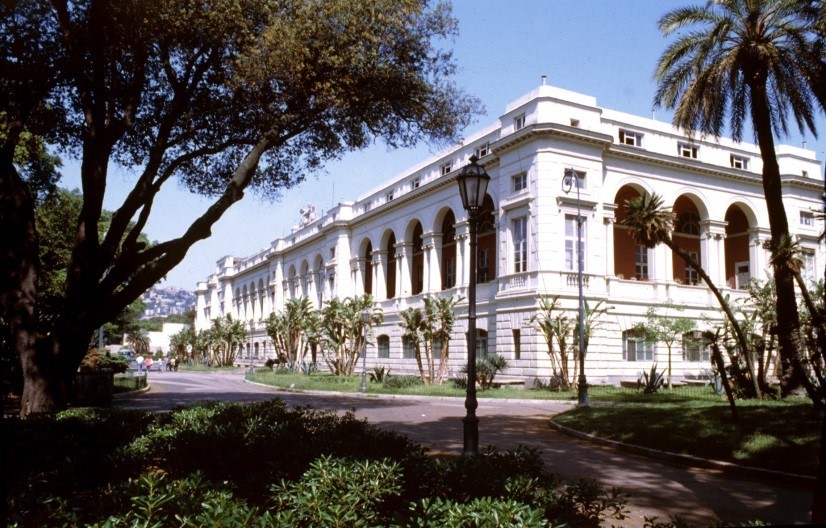 The workshop Genomic for a Blue Economy aims at identifying the state-of-the-art of methods, potential challenges, and future directions in the characterization of marine natural compounds and their applications as biotechnological and pharmaceutical products. The huge biodiversity hosted in the oceans stimulate the research for bioactive molecules from marine bioresources for applications in the field of biotechnology.
To exploit these promising biological resources and avoiding impoverishing marine resources, new strategies in the pipeline and a new cohort of cross disciplinary trained scientists are needed.
Systems biology approaches, such as genomics, transcriptomics, proteomics and metabolomics, are now being adapted to update natural product discovery platforms.
The two days workshop is organized in 4 sessions:
Session 1 - Omics technologies for drug discovery
Session 2 - Innovative OSMAC approach to improve marine secondary metabolism
Session 3 - Synthetic biology and pathways reconstruction
Session 4 - Panel discussion: Genome mining for drug discovery: state of the art and future paths
Have a look at the scheduled programme through the link: https://www.gbe-workshop.com/programme
Please be informed that the "Abstract Submission" procedure is now available through the web site. Authors are asked to submit a 300-words abstract using the information available at the web link: https://www.gbe-workshop.com/registration. Kindly feel free to contact us (This email address is being protected from spambots. You need JavaScript enabled to view it.) for any further queries.
We look forward to welcoming you in Naples!
Registration
To register visit to the Registration Page at https://www.gbe-workshop.com/registration
Registration includes:
a) participation in all the events during the two-days programme
c) coffee breaks
d) lunches
Contacts
Giovanna Romano
Valeria Di Dato
Stazione Zoologica Anton Dohrn
Tel 0815833430
E-mail: This email address is being protected from spambots. You need JavaScript enabled to view it.; This email address is being protected from spambots. You need JavaScript enabled to view it.
Organizing committee
Giovanna Romano (Stazione Zoologica Anton Dohrn)
Valeria Di Dato (Stazione Zoologica Anton Dohrn)
Donatella De Pascale (Stazione Zoologica Anton Dohrn)
CO-ORGANIZERS
Conxita Avila (Universitat de Barcelona),
Deniz Tasdemir (GEOMAR),
Leonard Van Zyl (University of Western Cape)
Flora Palumbo (Stazione Zoologica Anton Dohrn)
The institutional review visit that the Open University carries out every three years, aiming at assessing the quality of the PhD Program, in terms of training and research offered to PhD students according to the Quality Assurance Agency, UK standards; assigned the following judgments to the categories:
• student research environment: High confidence
• research degree policy and procedures: High confidence
• strategic commitment and fit: High confidence
The Open University also commended the investments for the new facilities and the new sites opening, the management and oversight arrangements of the PhD program, the students’ engagement in the institutional life, the transparency in the recruitment procedures and the excellent training opportunities offered to all students.
Roberto Danovaro, President of the Stazione Zoologica comments: This result makes us proud and encourages us to continue in improving and increasing our investments in the training of excellent young scientists of European level.
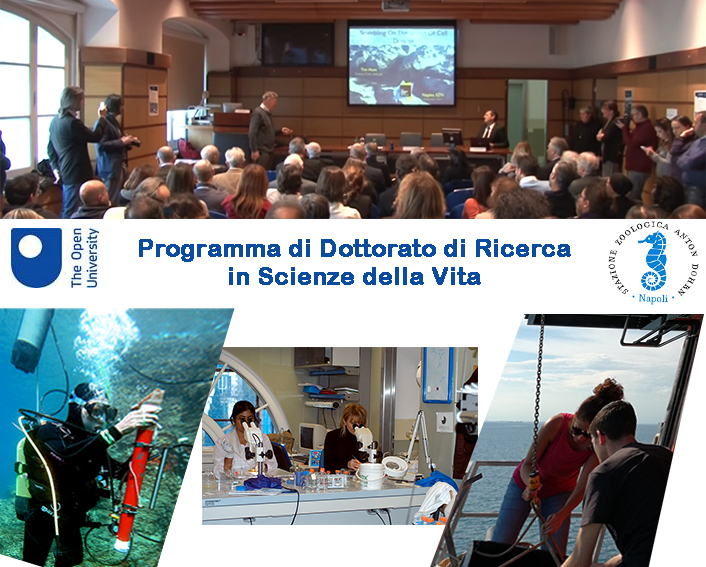
Ph.D. fellowships are available to carry out interdisciplinary training in Biological Sciences at the Stazione Zoologica 'Anton Dohrn' Naples Italy.
Applications are invited from suitably qualified postgraduate candidates (see details).
The closing date for applications is October 28th 2019 h. 12.00
Scadenza per la presentazione delle domande: ore 12:00 del 2 ottobre 2019


Copyright © 2015 by Stazione Zoologica Anton Dohrn Napoli - Italy
Villa Comunale, 80121 Napoli - Tel.+39 081 5833111 - C.F./P.IVA : IT 04894530635 - PEC: ufficio.protocollo(at)cert.szn.it